48-volt house power on an older trawler
On this page
Our goal is simple to say and hard to build: run the whole boat from batteries through a hot Florida night, air conditioning included, with both generators off. On a 1986 trawler with a 12-volt house system, that means a new electrical backbone. We chose 48 volts. This guide explains why, what we’re planning, and what we’re still checking before the first wire gets cut.
This is our plan, not a finished install. We’ll update it as the work happens, including the parts that don’t go to plan.
The boat we’re starting with
Hot ’n Dirty is a 1986 DeFever 57 with twin Caterpillar 3208 TA diesels, a 12 kW and a 20 kW Northern Lights generator, a 12-volt DC house system and 120/240-volt split-phase AC. Shore power comes in through four 50-amp inlets, two on the bow and two aft, and a shielded isolation transformer.
The big loads are what make this interesting:
- A 60,000 BTU chilled-water air conditioning system, driven through a variable-frequency drive
- A Sea Recovery watermaker
- An electric range, a 20-gallon water heater, a washer and dryer, and a cold-plate fridge and freezer
- A Maxwell windlass that pulls 130 to 160 amps working and far more at stall
The existing inverter is a 2 kVA modified-sine unit. It was never meant to carry any of that, so it will be replaced.
Why 48 volts
Current goes down as voltage goes up. The same load draws a quarter of the current at 48 volts that it draws at 12. That means smaller cable, smaller fuses, less heat and less voltage drop. A cooling load that needs 1/0 or 2/0 cable at 12 volts can run on about 10-gauge wire at 48.
The second reason is certification. American Boat and Yacht Council (ABYC) standards require inverters on boats to carry the UL 458 marine listing. When we compared the 48-volt inverter/chargers that could carry our loads, only one carried UL 458: the Victron MultiPlus-II 48/5000. That settled the brand question for us. Please educate us if you have more efficient, lower-cost suggestions.
What goes in
Inverter/chargers. Four Victron MultiPlus-II 48/5000 units in a split-phase arrangement, two per leg. Together they’re rated about 16 kW at 25°C and a little under 15 kW in a hot engine space. Two units would carry the air conditioning alone. Four carry the air conditioning and the watermaker at the same time, which is the combination we expect on a summer afternoon at anchor.
Batteries. Eight Epoch 48-volt, 100 amp-hour lithium iron phosphate batteries (subject to change as I am still researching batteries), for about 41 kWh. We plan to use 80 percent of that, which is about 33 kWh. Our estimated overnight load is about 3 kW, mostly air conditioning, so that bank should carry about 10 hours. We chose Epoch for its certified cells (UL 1642 and IEC 62619), an internal Class T fuse in each battery, a waterproof case, self-heating for cold weather and native Victron communication. Before we buy, we want Epoch to confirm in writing that this model works with Victron’s battery management on the Cerbo. Some owners have reported problems with other Epoch models, and we’d rather ask now.
Weight and placement. Eight batteries weigh about 776 pounds. That weight needs to stay low and near the centerline. The engine room is already full, so the lazarette is our first choice and the old house battery trays are second. ABYC also rules out mounting directly above or below a fuel tank. Victron asks for the inverters to go in a separate, ventilated space from the batteries, never above them, so we’re looking for a spot next to the bank rather than in the same locker.
Control. A Victron Cerbo GX with a touch display ties everything together. Two of its relays do real work: one sheds the range, water heater and dryer when we’re on battery, with an override switch, and one starts the generator automatically.
Solar. Six 400-watt panels, about 2.4 kW, on the flybridge top through one MPPT charge controller. On a Florida day that should make about 8 kWh. That covers daytime hotel loads, not the air conditioning. A yard will check the top’s frame before anything goes on it.
The whole system on two pages
The first drawing shows every part and every connection: shore power, generators, the four inverters, the battery bank, solar, the 12-volt system and the data links. Each part has a photo and a tag saying whether the photo is the exact model, a close relative or our own boat. The second shows roughly where things go. Click either one to open it full size, then zoom in to read the details.
Single-line diagram: every source, fuse, cable size and data link, with a photo of each part.
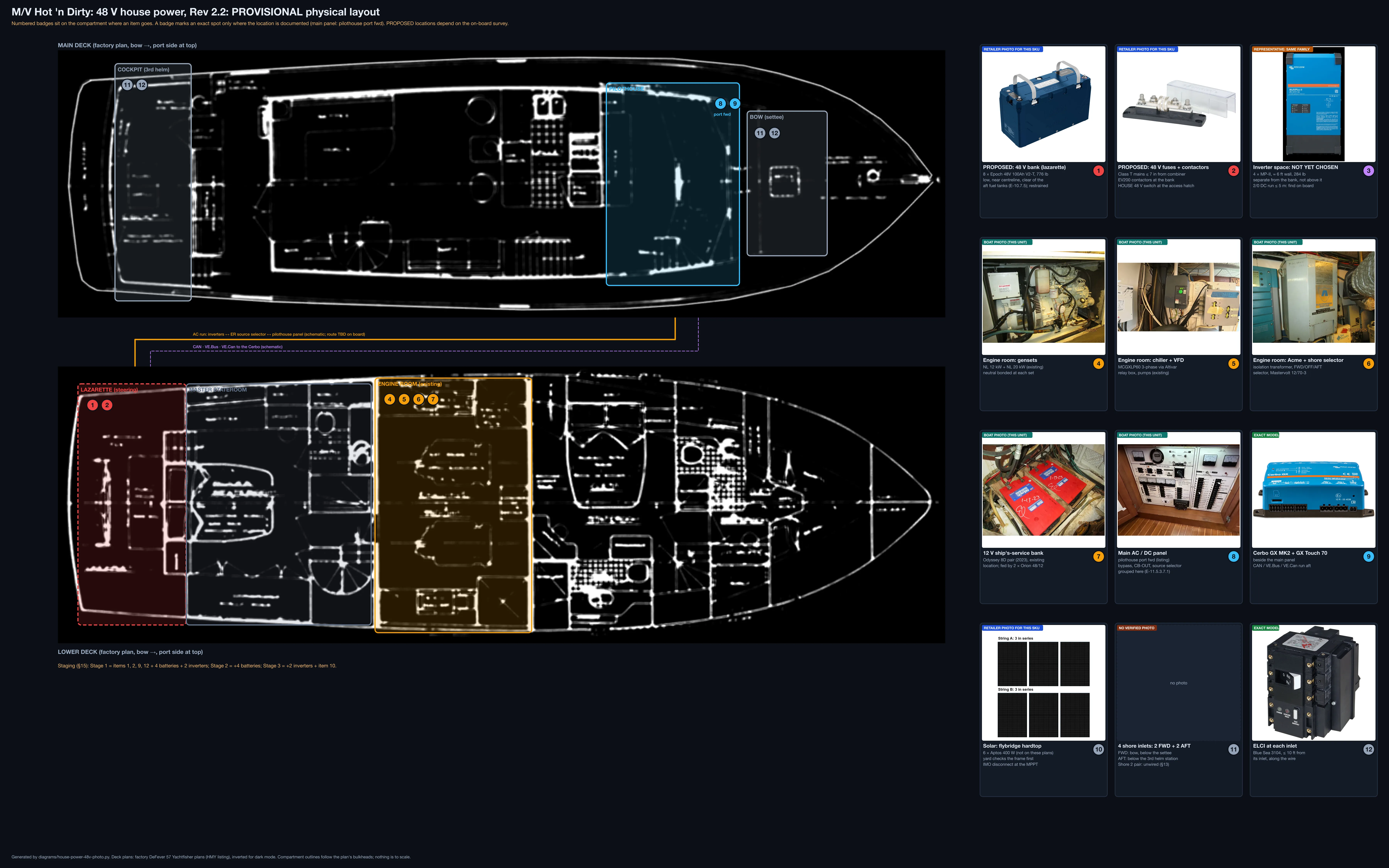
Where things go, over the factory deck plans. Only the engine room, pilothouse panel and lazarette are fixed; the rest gets confirmed aboard.
What stays 12 and 24 volts
We’re not rewiring the whole boat. The 12-volt DC panel, navigation electronics, stabilizer controls, heads, windlass, davit and engine starting all stay on 12 volts. The 24-volt bow thruster stays as it is. Two isolated Victron Orion 48/12 converters keep the 12-volt ship’s-service bank charged from the lithium bank, and the existing 12-volt batteries stay in place to handle windlass and davit surges.
This split is deliberate. If the lithium bank’s battery management ever shuts it down, the engines still start, the navigation stays on and the windlass still works. Lithium and lead-acid or AGM never connect directly; they only meet through the isolated converters.
The engine alternators stay 12-volt for now and charge only the start batteries. A 48-volt alternator on one main engine is a possible phase two, not part of this budget or near-term plan…again, subject to change before implementation.
Shore power and generators
We have four 50-amp inlets: two on the bow under the settee and two aft under the cockpit helm station. The factory manual for these DeFevers describes the same pattern: one 125/250-volt inlet for the house and a second, separate inlet the factory reserved for air conditioning. We only need one of each pair. One 50-amp cord runs the whole boat, so the second inlet at each end gets disconnected and labeled.
We’re keeping the isolation transformer. It lets us plug into a 50-amp 120-volt dock or a 50-amp 120/240-volt dock and still get 120/240 volts aboard, and it removes the need for a galvanic isolator. It has to carry the UL 1561 listing and be big enough for the breaker in front of it; if it isn’t, it gets replaced. Each inlet we use, forward and aft, gets its own ELCI breaker within 10 feet of the inlet.
Our rule at the dock is simple: the air conditioning or heat runs all the time, and the other big loads, like the oven, the dryer, the microwave or the watermaker, run one at a time alongside it. That comes to about 10 to 11 kW at the very worst, and one 50-amp 120/240-volt pedestal gives 12 kW. When a dock gives less, the inverters make up the difference from the batteries and recharge them when there’s room. Nothing trips.
Here’s what we expect to plug into:
| At the pedestal | What we use | What runs |
|---|---|---|
| One 100-amp outlet | An adapter to our 50-amp cord | Everything |
| One or two 50-amp 120/240-volt outlets | One 50-amp cord | Everything |
| Two 30-amp outlets | A reverse Y into the 50-amp cord | Air conditioning or heat; the batteries cover the oven or dryer while it runs |
| One 30-amp outlet | A 30-amp adapter | Not enough for the air conditioning by itself; the batteries carry it for half a day or more, then a generator starts |
| An old three-wire 50-amp outlet | A 50-amp 125-volt adapter | One leg at 50 amps |
On a 120-volt-only dock, the inverters can top up the shore supply from the batteries, so the 240-volt air conditioning still runs, for as long as the batteries hold.
The generators become chargers more than power plants. Taking the bank from 20 to 90 percent should take about two hours on the 20 kW generator, and about three on the 12 kW.
Safety and the standards
Forty-eight volts sits above the 50-volt level that ABYC treats as a shock hazard, and a lithium bank can deliver an enormous short-circuit current. The design follows from those two facts:
- Every 48-volt component is rated for at least 60 volts DC.
- Class T fuses within seven inches of the battery, and a Class T fuse on every 48-volt branch.
- A separate fuse or breaker on each inverter’s input and output, set up so they all trip together.
- Two high-current contactors with a lit remote switch serve as the battery disconnect, because no manual battery switch is rated for 60 volts at 400 amps.
- Covers on every positive terminal.
- A heat detector over the bank. An engine-room fire suppression system won’t stop a lithium thermal event, so early warning matters.
- One neutral-to-ground bond in every mode: at the transformer on shore power, at the generator on generator power, and at one inverter on battery.
Where the design can’t meet a standard as written, we’ve documented the deviation and the reason. We’ll have the final drawings reviewed before installation.
What it costs
Parts for the 48-volt system come to roughly $36,000 to $42,000, before labor. The batteries are about half of that. We may build it in three stages to spread the cost: first the wiring for the whole system with four batteries and two inverters, then four more batteries, then the last two inverters and the solar. Because the first stage is wired for the full system, nothing gets torn out later. Cable, switchgear, the battery shelf and the solar mounting add a few thousand dollars each. We’ll post real numbers on the Costs ledger as we buy.
What we’re still checking
A plan is only as good as its measurements. Before we commit, we’re confirming:
- The transformer’s rating and listing
- What each of the four shore inlets is, and where the unused pair’s wiring goes
- The air conditioning drive’s input current, and that it runs cleanly on inverter power
- The lazarette’s size and temperature, the aft fuel tanks (200 gal each) sit port and starboard along the sides of the lazarette as well for consideration.
- How much weight the current flybridge top structure can carry; it’s a welded aluminum structure.
- The breaker ratings on the original DC panel
- Real clamp-meter readings of every major load
We’ll report what we find, including anything that changes the design.